
The weekly Torah portion for Shabbat
“And the foreigners who join themselves to HASHEM to serve
Him and love the Name of HASHEM to become servants unto
Him, all who guard the Shabbat against desecration, and grasp
My covenant tightly-“
Isaiah 56:6
Shabbat for happiness and justice
“Praiseworthy is the man who does this and the person who
grasps it tightly: who guards the Shabbat against desecration
and guards his hand against doing any evil.”
Isaiah 56: 2
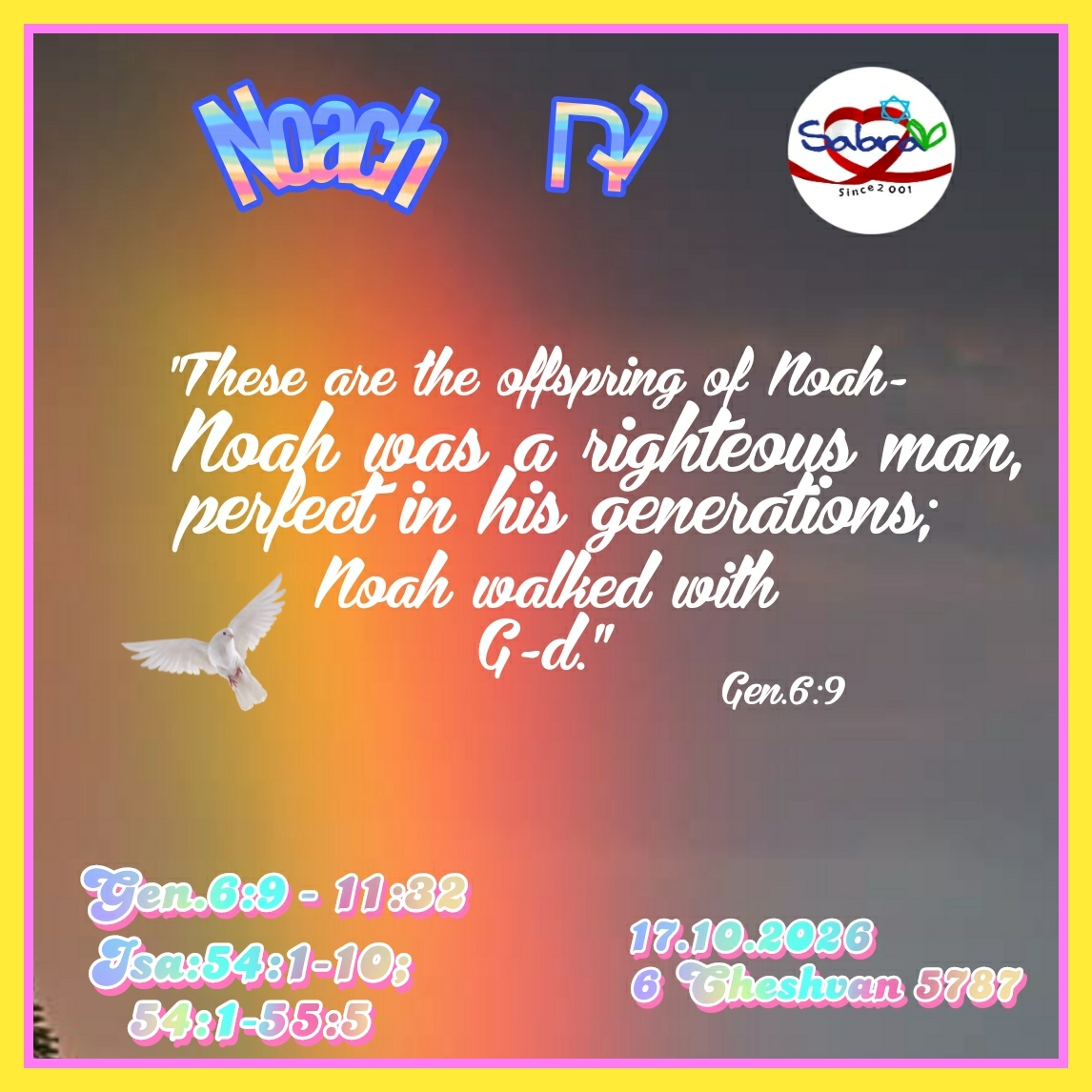
A Drop of Light from Zion
When the World Is Stormy — the Covenant Remains Unbroken
From Noah to the Comfort of Zion: Faith, Responsibility, and Hope for Our Generation
An extended reflection on Parashat Noach and its Haftarah, “Sing, O Barren One” | Mordechai ben Yaakov
Torah portion: Genesis 6:9–11:32 | Haftarah focus: Isaiah 54
Shabbat Shalom, beloved friends around the world. Blessings from the hills of Galilee and the hills of Jerusalem…
There are storms we see through the window, and storms that rage within the heart. At times we seek a safe place for our families. At other times we ask an even deeper question: How can I preserve my soul, my conscience, and my capacity to love in a world that seems to be losing its way? The Torah portion of Noah meets us in that place. It tells of corruption and deliverance, of a man building an ark, and of a family called to leave it and begin again.
Alongside the Torah portion, we hear the voice of the Haftarah, the accompanying reading from the Prophets. Isaiah addresses Zion, who has known abandonment and turmoil, and proclaims steadfast love and a covenant of peace. In the prophet’s words, the waters that threatened to erase life become the backdrop to an oath of faithfulness. As Noah’s story meets the promise of comfort for Zion, we are invited to ask what the God of Israel requires of us today: how to live with integrity, how to take responsibility for others, and how to turn love for Israel into a lasting bond of prayer, kindness, and action.
The Lord’s faithfulness to His covenant gives our hope a foundation; our responsibility is to give our faith expression in the way we live.
The Haftarah for Noach begins at Isaiah 54:1. In Sephardic custom it ends at verse 10; in Ashkenazic custom it continues through Isaiah 55:5. This article focuses on chapter 54, shared by both readings. Scripture excerpts are translated from the Hebrew for this article. References follow Hebrew Bible numbering; where common English numbering differs, the footnotes provide both. “The Lord” represents the divine name.
Contents
One Person Facing the Habits of an Entire Generation
When Injustice Becomes a Habit
Widening Our Circle of Responsibility
Faith Learns to Build
- From Life at Sabra: Even in the Storm, There Is Room for Someone Else
Even Behind a Closed Door, We Are Not Forgotten
One Leaf of Hope
- From the Song: From Noah’s Olive Leaf to the Heart of Sabra
The Courage to Step Outside and Return to Life
Honoring the Image of God
From the Family That Was Saved to the Family Called to Bless
The Waters of Noah Bear Witness to the Covenant
Enlarging the Tent and Strengthening Its Stakes
The Holy One of Israel and the God of All the Earth
The Mountains May Depart, but His Love Remains
When Israel Faces the Storm, You Too Have a Place in the Family
One Person Facing the Habits of an Entire Generation
Righteousness Is Tested Where We Live
“Noah was a righteous man, blameless in his generation; Noah walked with God.” (Genesis 6:9)
The Torah does not present Noah in isolation. It places him within a particular generation, amid corruption, and there it bears witness to his righteousness. It is easy to speak of integrity when integrity is respected. The test becomes harder when dishonesty pays, when compassion is mocked, and when remaining true to one’s conscience comes at a cost. Noah teaches us that our surroundings have great influence, yet they do not remove our responsibility to choose.
Drawing on the Jewish roots of interpretation, Rashi presents two ways of reading the words “in his generation.” Some see praise for a man who remained righteous in a corrupt age; others understand his righteousness as relative when compared with Abraham’s. These readings open two complementary questions: How am I living within the circumstances given to me, and toward what further growth am I still being called?[1]
The book of Psalms describes a person who chooses where to stand and which path to follow, comparing him to a tree planted beside streams of water. The prophet Micah describes the way through justice, love of kindness, and walking humbly with God. In both passages, faith is expressed through a way of life, through choices and habits.[2]
For a believer who loves Israel, such a stand may also require courage: learning the facts before sharing an accusation, refusing hatred toward Jews, and continuing to listen to one’s conscience even when doing so wins no approval. At the same time, love of truth requires us to examine ourselves with humility.
Am I allowing the voice of the majority to decide for my conscience, or am I making room for the word of the Lord to guide my way?
One person who remains faithful to what is good can keep a door of hope open for an entire generation.
When Injustice Becomes a Habit
Destruction Begins in Our Relationships with One Another
“The earth was corrupt before God, and the earth was filled with violence.” (Genesis 6:11)
The words “was filled” describe something pervasive. Injustice becomes the atmosphere people breathe, a way of life to which they grow accustomed. A person may continue working, buying, and building while ignoring the gradual erosion of basic trust. When the strong feel entitled to take from the weak, when falsehood becomes a working tool, and when no one expects fairness anymore, the foundations of society are damaged.
Drawing on the Jewish roots of interpretation, Rashi emphasizes robbery in his explanation of the Hebrew word chamas and its place in the judgment upon the generation of the Flood. The biblical word describes wrongdoing and violence; its meaning must be understood from its biblical context. Reading it calls us first to examine our own conduct and our relationships with others.[3]
Amos cries out against those who trample the poor and needy, calling for justice and righteousness to flow like an enduring stream. Isaiah demands that people cease doing evil, learn to do good, and defend the orphan and the widow. These passages teach us that the way we treat the vulnerable is part of serving the Lord Himself.[4]
The application begins close to home: fair payment, repayment of a debt, truthful speech, and respect for those who cannot defend themselves. A community that speaks often about faith must also examine how it treats people without status or influence. Faithfulness becomes visible when we have the power to exploit someone and choose instead to act justly.
What injustice have I grown used to, and what can I do to stop cooperating with it?
Repair begins when another person’s pain becomes our concern again.
Widening Our Circle of Responsibility
From Noah to the Prayers of Abraham and Moses
Noah does what the Lord commands, building an ark to save his family and preserve the animals. Later in the Torah, we meet Abraham approaching the Lord concerning Sodom, and Moses pleading for Israel after the sin of the golden calf. Reading these accounts together raises a question about the responsibility of a person of faith toward those beyond the walls of their own home.[5]
Abraham knows that Sodom is sinful, yet he asks for justice that distinguishes between the righteous and the wicked. Moses acknowledges the people’s sin, yet he does not abandon his plea on their behalf. Here is a love that can recognize wrongdoing without denying it, while continuing to seek mercy and restoration.
“Far be it from me to sin against the Lord by ceasing to pray for you.” (1 Samuel 12:23)
Samuel speaks these words to a people who have disappointed him by asking for a king. His spiritual responsibility continues even when the relationship is painful. This is a lesson for leaders, parents, and all who carry others in prayer: disappointment need not close the heart. We can set a boundary, speak the truth, and continue to seek another person’s good.
When we pray for the peace of Israel, let us picture real people: children, older people, anxious families, and those carrying wounds no one can see. Our prayer also reaches toward an end to violence and the protection of innocent lives. It opens our hearts to ask what practical part we ourselves can take.
Whom have I stopped carrying in prayer because they are far away, different from me, or have disappointed me?
Our spiritual responsibility grows when another person’s home finds a place in our prayers.
Faith Learns to Build
From the Promise to the Work of Each Day
“Make yourself an ark of gopher wood.” (Genesis 6:14)
Noah receives dimensions, instructions, and the duty to gather food. God’s promise does not turn him into a spectator waiting on the sidelines. He must act. There is spiritual depth in that work: piece by piece, day after day, a person gives tangible form to faithfulness. Even tasks that seem small or merely practical become part of preserving life.
In the book of Nehemiah, we encounter a community that prays and also sets a guard. The Torah commands a person to build a parapet around the roof of a house. In both cases, human responsibility is exercised within faith in the Lord. Prayer can strengthen our hands to fulfill our duties, prepare wisely, and protect others.[6]
“Is it not to share your bread with the hungry, and bring the homeless poor into your house?” (Isaiah 58:7)
Isaiah gives faith a practical expression: bread, a home, and clothing. Each such act requires someone willing to give time, strength, and care—and sometimes to return and do it again the following day.
We can think of every home and community as a place where lives are safeguarded: a person is welcomed with dignity, a child learns to trust, someone who is lonely finds a listening ear. This is an application of the ark’s story to our lives, inviting us to ask what kind of space for safety and kindness we are building.
Which of my prayers could take the form of a specific action this week?
The hands that build carry forward the prayer of the heart.
Inside the Ark, We Learn to Care for Life
“Take for yourself some of every kind of food that is eaten, and gather it to you; it shall be food for you and for them.” (Genesis 6:21)
Noah must gather food for the animals as well. The Torah does not describe the daily routine of those inside the ark, but the command to provide food shows that preserving life requires preparation and work. Within the place where Noah seeks safety for himself, other lives are entrusted to his care.
We can therefore reflect on the ark as a home that teaches responsibility. In a world filled with violence, where people take what is not theirs, Noah must prepare what will also be given to others. A moral contrast emerges from the two descriptions: outside the ark, life is being corrupted; inside it, life is being preserved. Deliverance includes an opportunity to learn a different way of living.
“A righteous person knows the needs of his animal.” (Proverbs 12:10)
Proverbs connects righteousness with recognizing the needs of a creature dependent on human care. The Torah also commands us to help an enemy’s donkey struggling under its load, and includes the rest of the ox and donkey among the purposes of Sabbath rest. Compassion is tested by our willingness to notice a need and respond, even when we feel no affection for the animal’s owner. These passages extend the principle of responsibility for life beyond Noah’s story.[7]
Even in the Storm, There Is Room for Someone Else
When I read about Noah gathering food for the ark, I think of the responsibility we take upon ourselves at Sabra House. One short phrase from the verse stays with me: “for you and for them.” You have needs, a family, and worries of your own—and alongside all of these, someone else needs you too.
Through our work at Sabra, we meet Holocaust survivors, older people, families in distress, and new immigrants from different countries. Each person carries a life story. The phrase “a family in distress” does not tell us who the children are, what troubles the parents, or what they hope tomorrow will bring. Nor can the words “Holocaust survivor” contain a whole lifetime of memories, loss, rebuilding, and love. To truly meet a person, we must make room and listen.
Here I find a deep connection with the ark. Noah had to prepare space and food for the lives entrusted to him. This leads me to examine myself as well: amid all the tasks, do I still see the person? Alongside the help we offer, are we giving personal attention and preserving the dignity of those who receive it? Sometimes kindness requires us to stop, listen to a story all the way through, and discover what is truly needed.
When I say, “Sabra is family,” this is the responsibility I want to express. A family remembers that needs will still be there tomorrow, and that a relationship requires continuity. This work is made possible by many hands and hearts willing to share the responsibility. None of us can do everything; each of us can take a part. In such mutual care, there is room for the giver’s weariness and need for help too.
The Torah portion of Noah invites me to ask: Within the home I am seeking to protect, for whom else can I make room? Perhaps a lonely neighbor, perhaps a family needing help, or perhaps someone waiting for a person who will listen without looking at the clock.
The ark teaches me that caring for life begins with a simple recognition: another person’s life has, in some measure, been entrusted to my hands as well.
Within that responsibility, there are also times of waiting. We do what we can, yet sometimes still ask when the storm will pass. The next verse speaks into that place.
Even Behind a Closed Door, We Are Not Forgotten
“God remembered Noah.” (Genesis 8:1)
The verse does not end with Noah. God’s remembering includes the wild animals and livestock with him in the ark. Then a wind passes over the earth, and the waters begin to subside. Here, the language of remembering marks a turning point toward deliverance; it need not mean that God had previously forgotten Noah. The reader sees a movement toward life while those inside the ark are still waiting.
There is deep comfort in this detail: being remembered does not mean leaving immediately. The waters recede, the ark comes to rest, the mountain peaks appear, and only later comes the command to go out. The deliverance described in this chapter unfolds in stages. Noah must continue waiting even after change has begun. We can learn patience from this without promising that every hardship in our lives will end in the same way or at the time we desire.
At the beginning of the deliverance from Egypt, we also read that the Lord heard the Israelites’ groaning and remembered His covenant with the patriarchs (Exodus 2:24). Their slavery did not end at that moment, but the story turns toward the mission that will be entrusted to Moses. In both passages, divine remembrance is connected with action in history, while the road to deliverance still takes time.[8]
“It is good to wait quietly for the salvation of the Lord.” (Lamentations 3:26)
The hope voiced in Lamentations rises from pain and devastation. It does not demand that a suffering person pretend everything is well. It offers words to hold on to when no answer is at hand. We too may pray with questions, ask for help, and admit honestly that waiting is hard. Faith can endure amid the tears.
As we approach the comforting words of the Haftarah, it is worth hearing Zion’s cry: “The Lord has forsaken me, and my Lord has forgotten me,” and the Lord’s reply: “I will not forget you” (Isaiah 49:14–15). This promise is spoken to Zion. His faithfulness to her allows the believer to learn about hope grounded in His word, while honoring the identity of the people whom the prophecy addresses.[9]
Can I continue to trust, seek help, and do the good within my reach even when the answer is not yet complete?
A closed door is not proof that God has forgotten you.
And in the midst of that waiting, a small, tangible sign will appear: an olive leaf in the dove’s beak.
One Leaf of Hope
Learning to Recognize a Beginning Before Everything Is Complete
“And there was a freshly plucked olive leaf in her beak.” (Genesis 8:11)
When the dove returns, Noah does not yet see a world full of life. He sees a leaf. The sign is small but real: beyond the ark, things are gradually changing. The Torah allows us to stand for a moment within that waiting, where there is still no complete resolution, yet there is already evidence that the waters have receded.
Zechariah asks who has despised the day of small beginnings, while Psalms describes those who sow in tears and the harvest of joy to come. These passages dismiss neither the tears nor the work along the way. They invite us to value the step we can take now, even when the outcome is still distant.[10]
From Noah’s Olive Leaf to the Heart of Sabra
When I read about the olive leaf the dove brought to Noah, I think of another leaf, one very close to my heart: the sabra cactus leaf that inspired the song I wrote for Sabra.
A sabra cactus grows in the courtyard of Sabra House. Among its thick, scarred pads is a small one shaped like a heart—the “leaf” of my song. Its shape is imperfect; it bears marks of injury. Yet it remains green and alive, and it inspires me. That leaf gave me a way to express in song something of the spirit I seek to preserve in the House of Good Deeds: a heart that has been hurt can still go on loving.
The olive leaf in the dove’s beak and the cactus leaf in our courtyard belong to different stories. For Noah, the leaf brought the knowledge that the waters had receded from the earth. For me, the cactus leaf became an image of life continuing amid pain. What connects them is the sight of a small sign of life with the power to make room for hope in the heart.
As I look at that heart-shaped leaf, I think of the people we meet at Sabra, and how important it is to see the person beyond the wounds: their dignity, their wishes, and the strength they still possess. We do not always know what they have endured, and sometimes there are no words that can bring immediate relief. We can stand beside them without demanding that they appear strong, allowing them to feel that there is room for their pain as well.
We who reach out to help also come with hearts marked by the journey. We need not wait until all our pain has passed before doing good. We can give and receive, offer encouragement and lean on a friend. This is how I understand the family we seek to build at Sabra: people making room for one another and continuing together.
Can I recognize, even within the wound, the life that still longs to grow?
Noah received a small leaf, and through it knew that something in the world outside the ark was changing. I look at the cactus leaf and see an imperfect heart that is nevertheless alive. This is the hope I sought to give a voice to in my song. In our lives, it may appear in a conversation renewed after estrangement, in a hand reaching out to help, or in someone finding the strength to ask for help.
Even a scarred heart can be a loving heart—and bring another person a small leaf of hope.
The olive leaf was a sign along the way. Later, Noah would hear the call to leave the ark and step onto the ground where life would begin again.
The Courage to Step Outside and Return to Life
Deliverance Opens a New Chapter of Responsibility
“Go out of the ark, you and your wife, your sons and your sons’ wives with you.” (Genesis 8:16)
At first, Noah is called to enter; later, he is called to leave. The place that preserved his life is not meant to remain his whole world forever. Beyond the door lies a world in need of rebuilding, care, and new life. The departure itself comes in response to the word of the Lord.
It is easy to understand why someone who has lived through a storm may struggle to trust again. We should not read this verse as a demand that a hurting person hurry up and get over it. We can hear it as an invitation to continue the journey at a responsible pace, with appropriate support. Sometimes the first step is renewing a relationship; sometimes it is accepting help; sometimes it is returning to a small, meaningful task.
Jeremiah tells the exiles in Babylon to build houses, plant gardens, and seek the welfare of the city. Precisely in a place of displacement, they are called to take part in life. Isaiah describes the rebuilding of ruins as part of the future opened by a life of righteousness and kindness.[11]
As we stand beside the people of Israel, that responsibility also extends to the days after the storm: recovery, education, livelihoods, and strengthening relationships. Friendship is tested by our willingness to remain close even after public attention has turned elsewhere.
Who needs me to keep walking beside them after the immediate crisis has passed?
The life that has been preserved now needs room to grow.
Honoring the Image of God
The Sanctity of Life Is the Foundation of the World Being Rebuilt
“For in the image of God He made humankind.” (Genesis 9:6)
After the Flood, the Torah emphasizes responsibility for human life. Its sacred worth does not depend on strength, possessions, age, or social standing. The human being bears the image of God. This verse comes within a solemn warning against bloodshed, setting a clear moral boundary against the taking of life.
Genesis 1 already connects human creation with the image of God. Proverbs adds that whoever oppresses the poor insults their Maker. Reading these passages together deepens our understanding: our faith in the Creator is also tested by the honor we give His creatures, especially those whose vulnerability exposes them to exploitation.[12]
Love for Israel calls us to protect Jewish lives and dignity and to reject antisemitism. That same recognition of the image of God requires us to distinguish between those who cause harm and those who are innocent, and to avoid language that strips a community or a people of its humanity. Resistance to evil can and must rest on moral discernment and the protection of life.
On a personal level, this touches the way we speak to an older person, treat someone with a disability, listen to a child, and offer help to someone ashamed to ask. A person does not become less precious because they need others.
Who near me needs to feel today that their dignity does not depend on what they can give me in return?
Human dignity becomes a practical test of our faithfulness to the Creator.
Shem and Japheth Protect Their Father’s Dignity
“They walked backward and covered their father’s nakedness.” (Genesis 9:23)
After his deliverance from the Flood, Noah is also shown in a moment of weakness: he drinks wine, becomes drunk, and lies uncovered inside his tent. The Torah does not conceal the failing of the man it has described as righteous. Shem and Japheth take a garment, walk backward, and cover him. They act so that their help does not increase his exposure. After the responsibility to preserve life, we encounter responsibility for a person’s dignity when he is not protecting it himself.
“Whoever covers an offense seeks love.” (Proverbs 17:9)
In the same verse, Proverbs warns against repeating a matter in a way that separates close friends. We can learn from this not to turn someone’s failure into a story circulated again and again. Yet the same chapter condemns those who justify the wicked. Protecting a person’s dignity does not require excusing their actions or silencing those they have harmed. Responsible love allows us to speak truth, protect the injured, and help bring about repair without humiliation for its own sake.[13]
Isaiah says, “When you see someone naked, clothe them” (Isaiah 58:7). In its plain meaning, this is a command to provide clothing for someone in need. Read alongside the actions of Shem and Japheth, it reminds us that another person’s exposure can move us to help. Even when clothing is not the need, we can protect an older person’s privacy, address a mistake in a respectful conversation, and help someone seek support without turning their distress into a public spectacle.
When someone’s weakness is exposed before me, what will I do to help without adding to their shame?
Kindness is also tested by the way we treat a person in a moment of weakness.
From the Family That Was Saved to the Family Called to Bless
The End of Noach Opens the Way to Abraham
After the Flood and the Tower of Babel, the Torah portion leads us to Terah’s family. Abram and Sarai appear within this family history, and at the beginning of the next portion the call “Lech Lecha”—“Go forth”—will be heard. The focus moves from humanity as a whole to a man and a family called to a mission.[14]
“Be a blessing”; “in you all the families of the earth shall be blessed.” (Genesis 12:2–3)
God’s choice of Abraham carries a purpose that reaches others. Later, Scripture explains that the way of his household is to be a way of righteousness and justice. A vital connection emerges: blessing for the families of the earth is also connected with the building of a household that knows the Lord and does what is right in His sight.[15]
Isaiah describes peoples seeking to ascend the mountain of the Lord to learn His ways. Zechariah portrays people from the languages of the nations wishing to walk with a Jewish man because they have heard that God is with him. These are images of closeness and learning that honor Israel’s identity and calling.[16]
Beloved friends, your relationship with Israel can grow from this place: getting to know people, listening, praying, and helping. When I say, “Israel is the vessel—God is the story,” I mean that looking at Israel leads us to reflect on the Lord’s faithfulness and the responsibility He entrusts to human beings. Such love gives the relationship a depth that goes beyond passing emotion.
What step will help me turn love for Israel into understanding, faithfulness, and responsibility?
A blessing becomes a calling when it reaches another person’s home as well.
The Waters of Noah Bear Witness to the Covenant
The Prophet Connects the Memory of the Flood with Comfort for Zion
“For this is like the waters of Noah to Me: as I swore that the waters of Noah would never again cover the earth, so I have sworn not to be angry with you or rebuke you.” (Isaiah 54:9)
Here is the explicit bridge between the Torah portion and the Haftarah. Isaiah does not mention Noah merely as a literary ornament. He uses the oath associated with the Flood to express the enduring force of the Lord’s promise to Zion. The memory of devastation is brought into the language of mercy and a future.
The covenant with Noah in Genesis 9 concerns humanity and every living creature. The promise in Isaiah 54 is addressed to Zion, portrayed as a forsaken wife. The covenant and the promise have different contexts, and the prophet himself connects them through the faithfulness of the God who speaks.[17]
Jeremiah sets the continued existence of Israel’s descendants alongside the fixed order of the sun, moon, and stars. Leviticus declares that even in the land of their enemies, the Lord will not destroy Israel or break His covenant with them. Neither passage overlooks sin, exile, or rebuke; both proclaim that divine faithfulness is not canceled by these realities.[18]
Therefore, as we read the promises of comfort for Zion, we should give Israel its rightful place in the verses. The believer from the nations is invited to rejoice in the Lord’s faithfulness to His people and to find in it a foundation for trust. Personal application grows out of the original promise while respecting those to whom it was given.
Do I read the Lord’s promises to Israel with the same seriousness with which I seek to trust His promises?
The comfort of Zion teaches us to know a God who remembers His covenant.
Enlarging the Tent and Strengthening Its Stakes
Openness and Stability Grow Together
“Enlarge the place of your tent… lengthen your cords and strengthen your stakes.” (Isaiah 54:2)
The prophet paints a picture of a home that will be filled. Zion is called to prepare for the increase of her children while strengthening what holds the tent in place. Expansion and deepening appear together in the same verse. This is comfort that also calls for preparation and action.
In community life, we can learn that opening our hearts requires firm foundations. Those who welcome more people must deepen their capacity to listen, accept responsibility, and remain faithful. A spacious tent needs secure stakes if it is to become a place people can trust.
Isaiah invites foreigners who join themselves to the Lord to His holy mountain and speaks of a house of prayer for all peoples. Solomon had already prayed that the Lord would also hear the foreigner coming from a distant land for the sake of His name. This wide invitation grows out of a relationship with the God of Israel, His name, and the place He has chosen.[19]
This is also the vision I seek to nurture at Sabra: a home in Israel and the closeness of family. We want friends from the nations to feel welcome, to learn and pray, and to let their love reach the people living here. Enlarging the tent requires us to strengthen the stakes of truth, Jewish roots, responsibility, and service.
How can I open my home and my heart while strengthening the values on which they rest?
A home of faith can safely grow wider as its roots grow deeper.
The Holy One of Israel and the God of All the Earth
A Relationship with Israel Opens a Horizon for the Nations
“Your Redeemer is the Holy One of Israel; He is called the God of all the earth.” (Isaiah 54:5)
Both titles appear in the same verse. The Holy One who is bound to Israel is the God of all the earth. Here is a key to understanding the relationship between Israel’s distinct calling and hope for the nations: the Lord acts within covenant and real history, while His sovereignty embraces the whole world.
Psalms teaches that the earth and all that fills it belong to the Lord. In another psalm, a prayer for Israel’s blessing opens toward the knowledge of His way on earth and His salvation among the nations. Again, we see the connection between a particular blessing and a wider calling: the good given to a people bears witness, inviting others to know the Lord.[20]
The believer who loves Israel therefore has a place of participation: recognizing that the biblical story is bound to a living people, rejoicing in blessing, and being willing to share burdens. People do not become family simply because they agree about an idea; family is also formed through listening, presence, and help in difficult times.
This calls for humility. We do not know all the ways of divine providence, and we must not turn every event into a certain prophetic declaration. Yet there are clear things we can practice now: loving kindness, doing justice, honoring Israel, and doing good to others.
Is my relationship with the God of Israel visible in the way I treat His people and His creatures?
Faith in the God of all the earth deepens as it also listens to His covenant with Israel.
The Mountains May Depart, but His Love Remains
Hope Rooted in the Lord’s Faithfulness
“Though the mountains depart and the hills are shaken, My steadfast love shall not depart from you, nor shall My covenant of peace be shaken, says the Lord, who has compassion on you.” (Isaiah 54:10)
Mountains and hills seem like symbols of stability. The prophet measures even these against the steadfastness of divine love. He is speaking to Zion, who has suffered; this promise is therefore no easy statement made by someone who has never seen devastation. It is spoken amid the memory of abandonment and declares that mercy has a future.
Psalm 46 speaks of the earth giving way and mountains shaking in the heart of the seas, yet within that very picture it declares God to be a refuge and strength. Lamentations finds an opening for hope within grief and recalls the Lord’s mercies, new every morning. Biblical hope knows how to hold a tear; it seeks a place where a person can stand and continue.[21]
We too have no right to promise someone that they will never hurt again, or to explain with certainty why tragedy has struck them. We can be present, pray with them, and hold on to hope. When we speak of the people of Israel, we read the promise with respect for the covenant and the identity of those addressed, longing to see its comfort expressed in life, peace, and rebuilding.
Beloved friends, the Torah portion of Noah leads us from one person choosing good to the responsibility of building, from waiting inside the ark to taking the first step outside. The Haftarah widens our view to Zion and the Lord’s faithfulness. Now the question stands before us: What will we build from what we have heard?
What faithful act can I undertake this week so that someone else feels less alone in the storm?
The covenant does not spare us the journey; it gives us strength to walk it faithfully.
When Israel Faces the Storm, You Too Have a Place in the Family
Concluding Chapter
Seeing Reality without Letting Fear Govern Our Faith
Beloved friends, when we lift our eyes from the verses to the world around us, we encounter deep concern among Jews in Israel and in Diaspora communities. Discussion of Israel fills headlines and screens, and in some places it is accompanied by threats, harassment, and violence against Jews. Behind the reports are people seeking to live, pray, raise children, and preserve their identity in safety.
This reality is documented. In the United Kingdom, for example, the Community Security Trust (CST) reported 1,926 antisemitic incidents in the first half of 2026, an increase of 21 percent over the corresponding period in 2025. In September 2026, representatives of seven major Diaspora Jewish communities also appealed to United Nations member states to confront antisemitism. These are examples of widespread concern; they do not mean that every nation or every person stands against Israel.[22]
There is room for substantive criticism of policies and actions in Israel, as in any country. But blaming Jews as Jews, threatening synagogues, or humiliating a person because they are Jewish attacks human beings and their dignity. Responsible faith requires us to distinguish, investigate, and resist hatred. Amid the difficulty, it is also important to recognize the friends standing beside Israel and those who refuse to let fear silence their conscience.
The Storm Does Not Tell the Whole Story
The Haftarah does not ask us to ignore distress. It addresses Zion as “afflicted, storm-tossed, and not comforted.” Yet in that same chapter we hear the promise of steadfast love and the covenant of peace. From this comes deep encouragement: a people’s condition at a particular moment does not encompass their future in the Lord’s sight.[23]
In the people of Israel—alive, praying, teaching their children, and building their lives—we see reason to give thanks and continue hoping. Through faith, we view history in the light of the covenant. Yet we do not possess a divine timetable, nor do we have authority to identify every war or crisis with a particular stage of prophecy. The promises guide our hope and our responsibility even when the details of the road remain hidden.
Enlarge Your Tent—There Is Room for You Too
“Enlarge the place of your tent… lengthen your cords and strengthen your stakes.” (Isaiah 54:2)
It is precisely Zion, bearing the memory of desolation, whom the Lord calls to enlarge her tent. This is a word of encouragement to the people of Israel: prepare for life, rebuilding, and the increase of your children. Even amid pain, there is reason to strengthen the stakes and make room for the future. The promise gives strength to continue, and the call to enlarge invites an act of faith.[24]
As we continue to Isaiah’s words about foreigners who join themselves to the Lord, a horizon of belonging opens for the believer from the nations as well. In the image of the tent, we can hear an invitation: there is room for you too, if you choose to respond to the call of the God of Israel, draw near to His people, and give your faith expression in your life. This is a free choice to accept responsibility, learn His ways, and hold fast to what is good even when the road is difficult.
In this way, the believer can find a place within the hope that God’s plan opens to the nations. We do not own the plan or determine its timing; we seek to live faithfully toward its purposes—the knowledge of the Lord, righteousness, kindness, and peace. Within the enlarged tent there is room for a friend from afar who chooses to draw close, share the burden, and rejoice in Israel’s comfort. Such friendship encourages both sides: Israel, knowing that loving brothers and sisters stand beside it, and the believer, knowing that love can become a calling.
The tent is expanding, and there is room for you too—a place of closeness, faithfulness, and responsibility.
The Believer from the Nations Need Not Stand Far Away
“Let not the foreigner who has joined himself to the Lord say, ‘The Lord will surely separate me from His people.’” (Isaiah 56:3)
This verse touches the heart of someone who loves the God of Israel and asks, “Is there a place for me too?” Later in the chapter, we read of foreigners who join themselves to the Lord, love His name, serve Him, and hold fast to His covenant. They are brought to His holy mountain, and His house is called a house of prayer for all peoples. This is a biblical invitation to belonging that carries faithfulness and a way of life with it.[25]
Dear friends, your love for Israel can be part of a life that responds to this invitation. You can pray, learn, stay in touch, and do good. You do not need to erase your country, language, or life story in order to draw near. Closeness is expressed through respect for the identity of the Jewish people and a willingness to walk beside them in love and responsibility.
There is a place for you—a place of closeness, prayer, and action—in friendship with the people of Israel.
Inside the Ark, What Will We Choose to Carry into the World?
We can picture the believer today as someone inside Noah’s ark: surrounded by a whirl of voices, wickedness, and antisemitism, while seeking within to preserve faith and humanity. This is a spiritual image we draw from the Torah portion. The ark reminds us of our need for a home of prayer, study, and faithful friends—a place where we can regain our footing and ask how to act.
“It went out, going to and fro” (Genesis 8:7); “there was a freshly plucked olive leaf in her beak” (Genesis 8:11).
The raven goes to and fro, while in the account of the dove’s mission a moment comes when she brings Noah an olive leaf. Scripture does not call the raven wicked, and both birds are God’s creatures. Our comparison is therefore an illustration of human choices: Will I remain caught among the voices of the storm, repeatedly spreading fear and anger, or will I seek out and bring something that strengthens life, as the olive leaf brought Noah the knowledge that the waters had receded?[26]
The choice is in our hands. Before passing on a message, we can check whether it is true and helpful. In the face of hatred, we can speak clearly for justice. To a hurting household, we can bring a visit, food, or a faithful word. The dove does not bring Noah a world already restored, but a small sign that allows him to continue waiting in hope. We too are not required to repair everything in a single day. We can bring the olive leaf we are able to carry.
There is movement within the ark’s story as well: at first the dove returns because she has found no resting place, and Noah stretches out his hand and receives her. There is room in the family for someone who set out, grew tired, and returned without an answer. You do not have to succeed in every task to be welcome. Later comes the day when she no longer returns, and Noah himself is called to leave. The sheltering home strengthens us for a life of responsibility in the world.[27]
What will I bring to our family and those around me this week—another echo of the storm, or an olive leaf of truth, kindness, and hope?
We can choose to carry hope into a stormy world.
The Prophetic Future Makes Room for the Nations
Zechariah describes a future in which many nations join themselves to the Lord. Isaiah portrays peoples ascending to learn His ways, and a future in which swords are turned into plowshares. The prophetic vision includes knowledge of God, justice, and peace. As we resist hatred and nurture relationships, we seek even now to direct our lives toward the good the prophets describe.[28]
“Blessed be Egypt My people, Assyria the work of My hands, and Israel My inheritance.” (Isaiah 19:25)
This vision opens the heart: Egypt, Assyria, and Israel appear together in blessing, each called by its own name. Even nations with a history of conflict are not presented as beyond the possibility of drawing near to the Lord. Hope for the future invites us to seek repair and peace while honoring Israel’s place as His inheritance.[29]
When you help an older person in Israel, teach your children to respect the Jewish people, or stand against lies and hatred, you give your love expression. Through faith, we can see such actions as a response to God’s call to kindness and participation in the good toward which the prophets point. We do not purchase a personal promise or guaranteed standing through them; we gladly accept responsibility.
You Have a Home in Israel
This is the heart of my invitation to you from Sabra: stay close. Take an interest in people, pray for them by name, learn the roots of faith, and choose a good deed you can sustain. Even someone far from Galilee can be close in heart and action. Family is built when we remember one another on quiet days and stand beside one another on difficult ones.
You have a home in Israel—Sabra is family. In these stormy times, you do not have to feel helpless or without a place to belong. Your love can strengthen lives, and your faithfulness can become someone’s olive leaf of hope. Let us walk together in humility, looking toward the peace the Lord has promised and ready to do today the good He has entrusted to our hands.
When the world is stormy, we can be a home for one another; faithful to the covenant, we will continue to nurture life.
Prayer and Blessing
God of Abraham, Isaac, and Jacob, give us faithful hearts in these stormy days. Teach us to hold fast to truth without losing compassion, and to act courageously without losing humility. Strengthen the weary in spirit, protect soldiers and civilians, heal the wounded, and comfort those who mourn. Spread Your peace over Israel and all who seek its good. Bless our friends in every land, and enable us to do good, strengthen a home, and open a door to hope. Amen.
With my prayer and blessing,
From the House of Good Deeds,
Mordechai ben Yaakov
Sabra House, Galilee, Israel
To receive extended articles and stay in touch: sabrafund@gmail.com
www.sabraholyland.org
[1] Rashi on Genesis 6:9, on “in his generation.” Both readings are presented as traditional interpretations alongside Scripture’s testimony to Noah’s righteousness.
[2] Psalm 1:1–3; Micah 6:8. Psalm 1 emphasizes a person’s path and source of nourishment; Micah brings together justice, kindness, and walking with the Lord.
[3] Genesis 6:11–13; Rashi on verses 11 and 13. A similarity of names alone does not establish a prophetic identification with a present-day group or event.
[4] Amos 2:6–7; 5:24; Isaiah 1:16–17. These passages emphasize justice and the protection of those who suffer wrongdoing.
[5] Genesis 6:22; 18:23–33; Exodus 32:11–14, 30–32. Noah’s story does not explicitly describe him praying for his generation; the absence of such a description does not prove that he never prayed for them.
[6] Nehemiah 4:3 in Hebrew numbering (4:9 in most English Bibles); Deuteronomy 22:8.
[7] Genesis 6:11–13, 19–22; Proverbs 12:10; Exodus 23:5, 12. The ark as a home that teaches responsibility is a moral reflection on the commands to preserve life and provide food, not an explicit description of its daily routine.
[8] Genesis 8:1–5, 13–16; Exodus 2:23–25. The comparison concerns divine remembrance and the unfolding of deliverance; it neither equates the patriarchal covenant with Noah’s covenant nor promises a personal timetable.
[9] Lamentations 3:21–26; Isaiah 49:14–16. Isaiah addresses Zion; encouragement for the reader is drawn from reflection on the Lord’s faithfulness to her.
[10] Genesis 8:10–12; Zechariah 4:10; Psalm 126:5–6. Zechariah speaks in the context of rebuilding the Temple; the connection with small steps in our lives is an application of the principle.
[11] Jeremiah 29:4–7; Isaiah 58:9–12. Jeremiah addresses the exiles in Babylon; we draw from his words a principle of building lives and accepting responsibility even in difficult circumstances.
[12] Genesis 1:27; 9:5–6; Proverbs 14:31. The saying that oppressing the poor insults their Maker connects our treatment of those in need with honor for their Creator.
[13] Genesis 9:20–23; Proverbs 17:9, 15; Isaiah 58:7. These passages support compassion and dignity alongside moral responsibility. They do not authorize concealing harm or withholding protection from those harmed.
[14] Genesis 11:26–32; 12:1–3. Abraham’s call appears at the beginning of Lech Lecha, the next Torah portion, and is included here as the continuation of Noach’s closing narrative.
[15] Genesis 18:18–19. The blessing of the nations and keeping the Lord’s way by doing righteousness and justice appear in adjoining verses.
[16] Isaiah 2:2–3; Zechariah 8:20–23. The passages portray peoples seeking the Lord and drawing close to Jerusalem and the Jewish people.
[17] Genesis 9:8–17; Isaiah 54:6–10. The connection lies in the prophetic comparison concerning the enduring force of the oath; it does not identify Noah’s covenant with every other biblical covenant.
[18] Jeremiah 31:34–36 in Hebrew numbering (31:35–37 in most English Bibles); Leviticus 26:44–45. Jeremiah’s verse numbering differs between Hebrew and many English editions.
[19] Isaiah 56:6–7; 1 Kings 8:41–43. In Isaiah, the invitation is linked to serving the Lord, keeping the Sabbath, and holding fast to His covenant. Solomon’s prayer emphasizes the nations’ knowledge of the Lord’s name.
[20] Psalm 24:1; Psalm 67:2–4 in Hebrew numbering (67:1–3 in most English Bibles). In Psalm 67, the request for blessing leads to the knowledge of God’s way on earth and the peoples’ praise.
[21] Psalm 46:2–4 in Hebrew numbering (46:1–3 in most English Bibles); Lamentations 3:21–24. Both passages express trust amid distress, rather than a promise of freedom from suffering.
[22] CST, Antisemitic Incidents January–June 2026, executive summary; [CST report]. J7 Task Force, open letter to UN member states, September 22, 2026, published by ADL; [J7 letter]. Sources checked October 12, 2026. CST’s figures describe incidents recorded in the United Kingdom, not a worldwide estimate.
[23] Isaiah 54:10–11. The description of the storm and the covenant promise appear in the same prophecy of comfort for Zion.
[24] Isaiah 54:1–3. In the prophecy’s plain meaning, enlarging the tent concerns Zion’s comfort and the increase of her children. The connection to believers from the nations is developed here with Isaiah 56:3, 6–7.
[25] Isaiah 56:3, 6–7. The promise is connected with joining oneself to the Lord, serving Him, keeping the Sabbath, and holding fast to His covenant; it is not an automatic promise based on emotional identification alone.
[26] Genesis 8:6–12. The raven’s movement and the dove’s mission are used here as an illustration of two possible human responses. This is not a biblical judgment that the raven is wicked, nor are the birds identified with nations or groups.
[27] Genesis 8:9, 12, 15–19. The narrative moves from returning and being received to the possibility of life outside the ark.
[28] Zechariah 2:15 in Hebrew numbering (2:11 in most English Bibles); Isaiah 2:2–4. These are visions of the future. The connection with the reader’s actions is an application of faith, not a claim about the timing of their fulfillment.
[29] Isaiah 19:23–25. The vision includes a highway, worship of the Lord, and a shared blessing for Egypt, Assyria, and Israel.